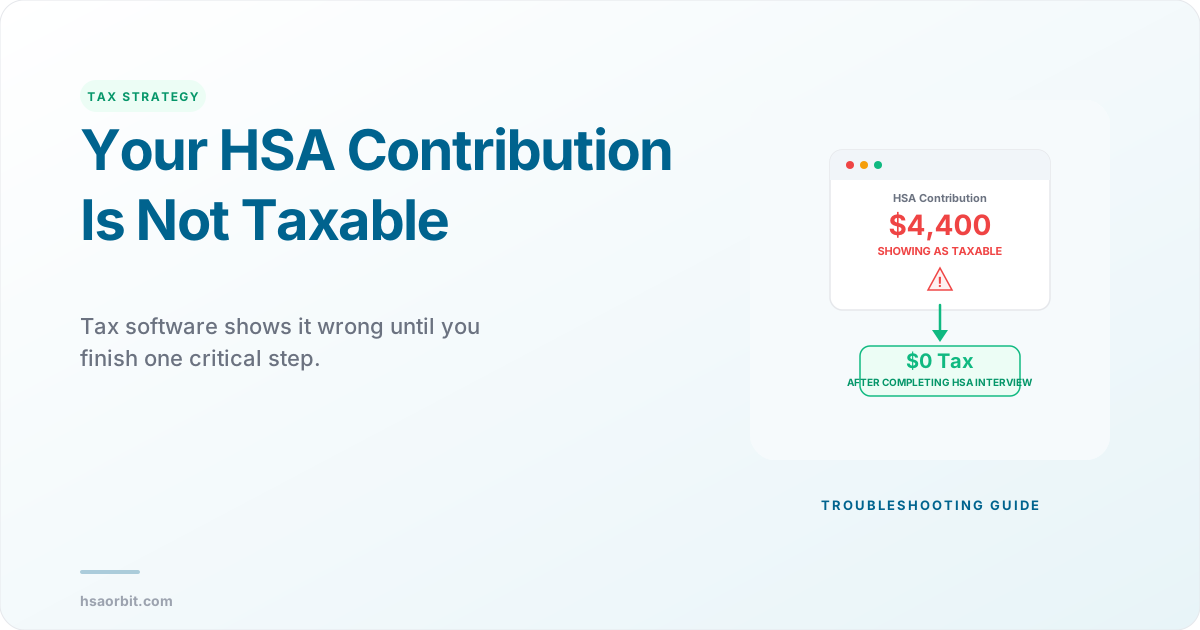
Every March, thousands of filers open TurboTax or FreeTaxUSA, navigate to the HSA section, and make the same expensive mistake: they double deduct HSA contributions that were already excluded from their taxable wages. The error looks innocent. Tax software asks "How much did you personally contribute to your HSA?" You contributed $3,600 through payroll, so you type $3,600. What you don't realize is that amount already appears on your W-2 in Box 12 with Code W, and the software already counted it. Now you've claimed the same $3,600 twice - once through the payroll exclusion, and again as a Line 2 deduction on Form 8889. The result? The IRS sees an excess contribution of $3,600, triggering a 6% excise tax that applies every year until you fix it. This mistake, which tax pros call "double deducting HSA contributions," is the single most common HSA error discovered during tax season, and understanding why it happens requires knowing the difference between two distinct tax treatments for the same dollars.
The Double-Count Trap
- Payroll contributions (Box 12 Code W): Already excluded from Box 1 wages - no deduction needed
- Direct contributions (outside payroll): Must be reported on Form 8889 Line 2 to claim deduction
- The mistake: Entering payroll amounts on Line 2 creates an artificial excess contribution
- The cost: 6% penalty tax every year the excess remains in your account
The Two Paths HSA Contributions Can Take
HSA contributions can reach your account through two fundamentally different routes, and only one of them requires you to claim a deduction on your tax return. Understanding this distinction is essential because the path your money takes determines how you report it - and whether you're entitled to a tax deduction at all.
The first path is through payroll deduction via a Section 125 cafeteria plan. When you contribute through payroll on a pre-tax basis through a Section 125 cafeteria plan, the IRS considers these to be employer contributions, and they are required to be reported in Box 12 of your W-2 using Code W. These dollars never appear in your Box 1 wages. Your employer withholds them before calculating your taxable income, Social Security tax, and Medicare tax. The tax benefit happens automatically at the payroll level.
Employers must report all employer and employee HSA contributions made through payroll as a single aggregated amount on the employee's Form W-2 in Box 12 using Code W. This means Box 12 Code W shows the combined total of what your employer contributed directly, plus what you contributed through payroll deduction. There's no breakdown showing which portion came from you and which came from your employer - it's all reported as one number.
The second path is direct contribution. You write a check to your HSA custodian, initiate an ACH transfer from your checking account, or mail in a contribution form. These contributions come from after-tax money - they were already included in your Box 1 wages and subject to all applicable taxes. You include on Line 2 of Form 8889 only those amounts you, or others on your behalf, contributed to your HSA for 2025, but you do not include employer contributions or amounts rolled over from another HSA or Archer MSA. Because you paid tax on this money when you earned it, you're entitled to claim a deduction to get that tax back.
The confusion arises because both paths put money into the same account, and both paths generate the same tax benefit - you ultimately get to exclude the contribution from your taxable income. But the mechanism differs. Payroll contributions are excluded before they ever hit your taxable income. Direct contributions must be deducted after the fact to remove them from your taxable income. Report the same contribution twice, and you've claimed the tax benefit twice.
Why Payroll Contributions Are Already Tax-Free
An employer's contribution, including an employee's contributions through a cafeteria plan, to an employee's HSA is not subject to federal income tax withholding or Social Security, Medicare, or railroad retirement taxes if it is reasonable to believe at the time of the payment that the contribution will be excludable from the employee's income. This is the key to understanding why payroll HSA contributions don't need to be deducted again.
When you elected to contribute $200 per paycheck to your HSA through your employer's cafeteria plan, you authorized your employer to reduce your taxable wages by that amount before withholding any taxes. If your gross pay was $4,000 and you contributed $200 to your HSA, your employer calculated your federal income tax withholding, Social Security tax, and Medicare tax based on $3,800 - not $4,000. The $200 was excluded from taxation at the source.
Look at your W-2. Box 1 shows your wages subject to federal income tax. Box 3 shows your wages subject to Social Security tax. Box 5 shows your wages subject to Medicare tax. All three boxes reflect the reduction from your HSA payroll contributions. Employers must report all employer and employee Health Savings Account contributions made through payroll as a single aggregated amount on the employee's Form W-2 in Box 12 using Code W. That Code W amount is informational - it tells you and the IRS how much went into your HSA through payroll, but it doesn't create a deduction you need to claim.
This differs fundamentally from direct contributions. If you earned $4,000 in gross pay with no payroll HSA deduction, all $4,000 appears in Box 1 of your W-2. You paid federal income tax, Social Security tax, and Medicare tax on the full amount. When you then contribute $200 directly to your HSA from your bank account, you're using after-tax money. Form 8889 Line 2 exists specifically to let you claim that contribution as a deduction and recover the income tax you paid on those dollars (though you cannot recover Social Security and Medicare taxes on direct contributions).
The distinction matters because the tax code treats cafeteria plan contributions as employer contributions for HSA purposes, even though the money came from your paycheck. Technically, all HSA contributions made through payroll deductions are considered employer contributions. This classification means they receive the employer contribution tax treatment: excluded from gross income entirely, reported in Box 12 Code W, and already reflected in your reduced Box 1 wages.
Form 8889 Line 2 vs Line 9: The Critical Difference
Form 8889 is the IRS form you must file whenever you contribute to or take distributions from an HSA. The form has three parts, but Part I is where the double-counting error happens. Understanding Lines 2 and 9 is essential to filing correctly.
Line 2 asks for contributions you or someone on your behalf made to your HSA for 2025, but specifically instructs you not to include employer contributions or amounts rolled over from another HSA or Archer MSA, and clarifies that payroll contributions through a salary reduction agreement elected by an employee under a cafeteria plan are treated as employer contributions and are not included on Line 2. Read that instruction carefully. Despite the fact that you authorized the payroll deduction and the money came from your paycheck, the IRS classifies cafeteria plan contributions as employer contributions for Form 8889 purposes. They do not belong on Line 2.
Line 2 is exclusively for contributions made outside your employer's payroll system. Examples include:
- A check you wrote directly to Fidelity, HealthEquity, or another HSA custodian
- An ACH transfer you initiated from your checking account to your HSA
- A contribution made by a family member on your behalf
- A contribution you made between January 1 and April 15, 2026 designated for tax year 2025
If every dollar you contributed went through payroll deduction, Line 2 should be zero or blank.
Line 9 on Form 8889 is where you report contributions to an HSA that were made through payroll deductions, and you should also include contributions from your employer, if any, here. This is the line that corresponds to Box 12 Code W on your W-2. When you enter your W-2 into tax software, most programs automatically populate Line 9 with the Code W amount. You don't need to do anything else.
You can find this total on your W-2, Wage and Tax Statement, in Box 12 with Code W. For example, if your employer contributed $1,000 to your HSA as a match or incentive, and you contributed $3,300 through payroll deduction, your Box 12 Code W shows $4,300. That entire $4,300 goes on Line 9. There's no way to separate out "your" portion versus "their" portion, and the IRS doesn't care about the breakdown. Both amounts receive the same tax treatment.
The math on Form 8889 Part I works like this:
- Line 3: Your maximum contribution limit for the year ($4,300 for self-only, $8,550 for family in 2025, plus $1,000 if you're 55 or older)
- Lines 4-8: Adjustments for things like Archer MSAs or partial-year coverage
- Line 9: Employer contributions including payroll deductions (from Box 12 Code W)
- Line 10: Qualified HSA funding distributions (rare)
- Line 11: Add Lines 9 and 10
- Line 12: Subtract Line 11 from Line 8 - this is your remaining contribution room
- Line 13: The smaller of Line 2 or Line 12 - your HSA deduction
If you put your payroll contributions on both Line 2 and Line 9, here's what happens: Line 9 already accounts for them and reduces your remaining contribution room on Line 12. But Line 2 now claims them again as additional contributions. Line 13 will likely show zero (because Line 12 is already zero or negative), and the software will flag an excess contribution equal to the amount you double-counted.
Important
Critical distinction: Line 2 is for contributions that need to be deducted because they were made with after-tax money. Line 9 is for contributions that were already excluded from your taxable income through payroll. The same dollars cannot appear on both lines.
How Double Counting Happens in Tax Software
Tax software is designed to walk you through your return in interview format, asking questions in plain language. The problem is that the plain language questions about HSA contributions are often interpreted incorrectly by filers who don't understand the payroll vs. direct contribution distinction.
When you enter the HSA interview in software like TurboTax, you see a screen headed "Let's enter your HSA contributions" with a first line showing the Code W amount from Box 12 of your W-2, and a second line asking for "the amount of HSA contributions that you sent directly to your HSA, NOT through your employer." The first line is auto-filled because you already entered your W-2. The second line is blank.
Here's where the mistake happens. You look at the second line and think, "Well, I personally contributed $3,600 to my HSA through payroll deduction. That's my personal contribution, not my employer's contribution." Many taxpayers mistakenly enter their payroll deductions on the second line, even though the instructions specifically tell them not to, because they think of these as "personal" contributions despite the fact that they should not be entered there.
The confusion is understandable. Your paycheck stub may even label the HSA deduction as "employee contribution" to distinguish it from any employer match. You see that label every two weeks, so when tax software asks about "contributions you personally made," you naturally think of the amount coming from your paycheck. But for tax purposes, "personal contributions" means direct contributions made outside payroll - not payroll deductions.
It is not unusual for taxpayers to accidentally duplicate their contributions by mistakenly entering what they perceive to be "their" contributions into the second line on the "Let's enter your HSA contributions" screen, when these contributions were actually made through a payroll deduction plan and are already included in the amount with Code W.
Different tax software packages present this question differently, which adds to the confusion:
- TurboTax: "Any contributions you personally made (not through your employer)"
- FreeTaxUSA: "Personal HSA contributions (not from W-2)"
- H&R Block: "Contributions you made directly to your HSA"
All of these are asking for the same thing - direct contributions outside payroll - but the wording can be misinterpreted. If you contributed exclusively through payroll, the correct answer to all of these questions is zero or blank, even though you did personally authorize and fund those contributions.
Another common scenario where double-counting occurs is when filers enter their HSA information in multiple places within the software. You enter your W-2, which captures the Box 12 Code W amount. Later, you navigate to the "Medical" section under "Deductions & Credits" and see an HSA entry screen. You enter your contribution amount again, not realizing that the W-2 entry already captured it. When you enter your W-2, tax software automatically records the Box 12 Code W amount in the HSA section, so you should not enter that amount again in the Medical section under Deductions and Credits on your return, as that will cause an excess contribution.
The software doesn't know whether you're entering the same contribution twice or reporting a legitimate direct contribution that's separate from your W-2 contributions. It takes your input at face value and generates Form 8889 accordingly. The result: your actual contributions appear on Line 9 (from Box 12 Code W), and then the same contributions appear again on Line 2 (from your manual entry), creating an artificial excess contribution equal to your Line 2 amount.
Calculate your correct deduction amount
Real Example: What Double Counting Costs You
Let's walk through a concrete scenario with real numbers to show exactly how the double-counting error unfolds and what it costs.
Sarah's situation in 2025:
- Self-only HDHP coverage all year
- Maximum contribution limit: $4,300 for self-only coverage
- Employer contribution: $500 (deposited in January)
- Employee payroll contributions: $3,800 ($158.33 per paycheck, 24 paychecks)
- Box 12 Code W on W-2: $4,300 (the $500 employer contribution plus $3,800 employee payroll contribution)
- Direct contributions: $0
Correct Form 8889 reporting:
- Line 2 (your contributions): $0 (all contributions were through payroll or employer)
- Line 3 (contribution limit): $4,300
- Line 9 (employer contributions): $4,300 (from Box 12 Code W)
- Line 12 (remaining contribution room): $0
- Line 13 (your deduction): $0
- Result: No excess contribution, no penalty
Sarah's Box 1 wages already reflect the $3,800 reduction from her payroll contributions. She paid federal income tax on $3,800 less than her gross wages. She already received the tax benefit. Line 13 correctly shows $0 because there's nothing additional to deduct - everything was already excluded at payroll.
Incorrect Form 8889 reporting (double-counting error): Sarah opens TurboTax and enters her W-2. The software captures the $4,300 from Box 12 Code W. Later, she navigates to the HSA section. She sees the question "Any contributions you personally made?" and thinks, "I contributed $3,800 through payroll deduction - that's my personal contribution." She enters $3,800.
- Line 2 (your contributions): $3,800 (incorrectly entered)
- Line 3 (contribution limit): $4,300
- Line 9 (employer contributions): $4,300 (from Box 12 Code W)
- Line 12 (remaining contribution room): $0 (4,300 - 4,300)
- Line 13 (your deduction): $0 (lesser of Line 2 ($3,800) or Line 12 ($0))
- Total contributions per Form 8889: $8,100 ($3,800 on Line 2 plus $4,300 on Line 9)
- Actual contributions: $4,300
- Excess contribution: $3,800
The IRS will assess a 6% excise tax on the $3,800 excess contribution, and this excise tax applies to each tax year the excess contribution remains in the account.
Year 1 (2025 tax return filed in 2026):
- Excess contribution: $3,800
- 6% excise tax: $228
- This tax is reported on Form 5329 Part VII and added to Line 17d on Schedule 2 (Form 1040)
Year 2 (2026 tax return filed in 2027): Assume Sarah doesn't catch the error and makes her normal 2026 contributions through payroll.
The excise tax applies to each tax year the excess contribution remains in the account. The excess doesn't go away on its own. If Sarah contributes $4,400 (the 2026 limit) in 2026, and the prior-year excess of $3,800 is still sitting in the account, she now owes another 6% tax on the $3,800.
- Excess contribution carried forward from 2025: $3,800
- 2026 contributions: $4,400
- 2026 contribution limit: $4,400
- New excess: $0 (she's under the limit for 2026)
- But the old excess from 2025 still exists
- 6% tax on $3,800: another $228
Year 3 (2027 tax return filed in 2028):
- Another $228 if not corrected
The penalty continues every year until Sarah either withdraws the excess amount or has a year where her contributions are low enough that the remaining contribution room absorbs the prior excess. You may be able to deduct excess contributions for previous years that are still in your HSA if the excess you can deduct is the lesser of your maximum HSA contribution limit for the current year minus any amounts contributed to your HSA for the year, or the total excess contributions in your HSA at the beginning of the year.
But here's the real problem: Sarah doesn't actually have an excess contribution at all. She contributed exactly $4,300, which was her limit. The "excess" is purely a reporting error - she told the IRS she contributed $8,100 when she actually contributed $4,300. Paying a $228 annual penalty for a contribution that never happened is particularly painful.
The fix requires Sarah to file an amended return (Form 1040-X) for 2025, correcting Line 2 on Form 8889 to show $0 instead of $3,800. You can file Form 1040-X up to three years from the original filing deadline, or within two years from the date you paid the tax, whichever is later. If she catches it before the 2025 return deadline passes, she can amend before paying any penalty. If she discovers it later, she'll need to amend and may be able to get the penalty refunded.
How to Check If You Double-Counted
You can verify whether you made this error by reviewing your Form 8889 even if you've already filed your return. Here's the diagnostic process:
Step 1: Locate your Form 8889 If you filed electronically, log into your tax software account and view or download your filed return. Form 8889 should be attached after Form 1040. If you filed by mail, retrieve your copy of the return you mailed.
Step 2: Check Box 12 Code W on your W-2 Find your W-2 and look at Box 12. If there's an entry with Code W, write down that amount. This is your employer + payroll contribution total for the year. If you had multiple jobs in 2025, check Box 12 on each W-2 and add up all Code W amounts.
Step 3: Review Form 8889 Part I Look at Line 2 ("HSA contributions you made for 2025"). If this line shows any amount other than zero, ask yourself: did I make any contributions to my HSA by check, ACH transfer, or direct deposit from my bank account - separate from payroll deduction?
If the answer is no - if 100% of your contributions came through payroll deduction - then Line 2 should be zero. Any amount on Line 2 represents double-counting.
Step 4: Compare Line 2 to Box 12 Code W This is the smoking gun test. If Line 2 on Form 8889 matches or approximately matches your Box 12 Code W amount, you almost certainly double-counted. For example:
- Box 12 Code W: $4,300
- Form 8889 Line 2: $4,300
- Form 8889 Line 9: $4,300
This pattern screams double-counting. You reported the same $4,300 on both Line 2 and Line 9.
Step 5: Check Part VII of Form 5329 If you double-counted, tax software should have generated Form 5329 (Additional Taxes on Qualified Plans) with Part VII completed. Code section 4973 imposes a 6% tax on excess contributions to an HSA. Look at Line 48 (or Line 43 in some years) - it should show your excess contribution amount. Line 49 or 50 shows the 6% tax calculation. If you see a tax amount on Form 5329 Part VII that equals 6% of your Line 2 amount from Form 8889, that confirms the error.
Step 6: Review your actual contribution sources Pull up your HSA account online or review your year-end statement from your HSA custodian. Most custodians break down contribution sources:
- Employer contributions
- Payroll contributions
- Direct contributions (sometimes labeled "individual contributions")
- Rollovers or transfers
Add up the employer and payroll contribution columns. They should match your Box 12 Code W amount. If the direct contribution column is zero or only shows a small amount that you genuinely made outside payroll, but your Form 8889 Line 2 is much larger, you've identified the discrepancy.
Pro Tip
Quick diagnostic: If you filed your return and got a refund smaller than expected, or owed more tax than expected, check for a Form 5329 in your return with a Part VII tax liability. An unexpected 6% additional tax is a strong indicator of the double-counting error.
What if you're not sure? If you're uncertain whether a specific contribution was through payroll or made directly, check your bank account transaction history. Did you write a check to your HSA or initiate an ACH transfer to HealthEquity, Fidelity, or another custodian? If yes, that's a direct contribution that belongs on Line 2. Did the money leave your paycheck before it hit your checking account? That's a payroll contribution that belongs only on Line 9 (through Box 12 Code W), not on Line 2.
Review your pay stubs from 2025. If you see a line item for "HSA contribution," "HSA deduction," or similar, those are payroll contributions. They should not be entered anywhere other than your W-2.
Verify your qualified expenses
Fixing a Double-Counted Deduction on a Filed Return
If you've already filed your 2025 tax return and now realize you double-counted your HSA contributions, you need to file an amended return using Form 1040-X. The process is straightforward, but you must act within the statute of limitations.
Timeline for amending: You must file Form 1040-X within three years from the date you filed your original return, or within two years from the date you paid the tax, whichever is later. For most 2025 returns filed by April 15, 2026, this means you have until April 15, 2029 to amend. However, if the amendment would reduce a tax liability or eliminate a penalty, amending sooner is better to stop additional interest from accruing.
If you haven't filed yet: If you're reading this before filing your 2025 return, simply correct Line 2 on Form 8889 before you file. Change it to show only direct contributions made outside payroll, or zero if you made no such contributions. Your tax software will recalculate Form 8889 and Form 5329 automatically. File the corrected return normally. No amended return is needed because you haven't filed the erroneous version yet.
Step-by-step amendment process:
1. Obtain Form 1040-X You can now file Form 1040-X electronically with tax filing software to amend your Form 1040, 1040-SR, or 1040-NR for the current or two prior tax periods. Most major tax software packages (TurboTax, H&R Block, FreeTaxUSA, TaxAct) support e-filing amendments for recent years. If your software doesn't support amendments or if you're amending a return from more than two years ago, you'll need to file by mail.
2. Gather your documents You'll need:
- A copy of your original 2025 tax return as filed
- Your 2025 W-2 showing Box 12 Code W
- Your 2025 Form 5498-SA from your HSA custodian (this shows total contributions for the year)
- Documentation of any direct contributions you made outside payroll
3. Correct Form 8889 In your tax software's amendment section, or on a fresh Form 8889 if amending by mail, enter the corrected information:
- Line 2: Enter only direct contributions made outside payroll. If you made none, enter $0.
- Line 9: Verify this matches Box 12 Code W from your W-2 (it should already be correct)
- Review Lines 10-13 to ensure they recalculate correctly
The corrected Form 8889 will likely show $0 on Line 13 (your HSA deduction) if all contributions were through payroll. This is correct - you're not entitled to an additional deduction because the payroll contributions were already excluded from your Box 1 wages.
4. Correct Form 5329 If your original return included Form 5329 Part VII showing an excess contribution and 6% tax, the amended return should either eliminate this form entirely (if no actual excess exists) or show the corrected excess amount. Most tax software will remove Form 5329 Part VII automatically when you correct Form 8889, since the excess contribution no longer exists.
5. Complete Form 1040-X On Form 1040-X, enter your income, deductions, and credits from your return as originally filed or as previously adjusted by either you or the IRS, the changes you are making, and the corrected amounts.
Form 1040-X has three columns:
- Column A: Original amounts from your filed return
- Column B: Net change (the difference you're correcting)
- Column C: Correct amounts (Column A plus or minus Column B)
The change will likely flow through as:
- A reduction in your total tax if you paid a 6% penalty on the phantom excess
- No change to your HSA deduction on Schedule 1 Line 13 (it should remain $0 both before and after)
- An increase in your refund or decrease in your tax owed (by the amount of the 6% penalty you no longer owe)
In Part III of Form 1040-X, explain the change: "Corrected Form 8889 Line 2 to remove duplicate reporting of HSA payroll contributions already included in W-2 Box 12 Code W. Eliminated excess contribution and associated 6% excise tax."
6. File the amended return You can use tax software to electronically file your Form 1040-X online. If e-filing, attach the corrected Form 8889 and any other affected forms. The software handles this automatically. If mailing, attach the corrected forms to Form 1040-X and mail to the appropriate IRS processing center for your state (the address is in the Form 1040-X instructions - it differs from the address for original returns).
An amended return takes up to 16 weeks to process. You can check the status using the IRS "Where's My Amended Return?" tool at IRS.gov after three weeks.
What if you already paid the 6% penalty? If you paid the 6% excise tax when you filed your original return, the amended return will show this as an overpayment. If you're due a refund, the IRS will send it to you after it accepts and completely processes your amended return. You'll receive a refund check for the penalty amount you overpaid.
What if you filed returns for multiple years with the same error? File a separate Form 1040-X for each tax year you are amending. If you made the double-counting error in 2023, 2024, and 2025, you'll need to file three separate amended returns - one for each year. The good news: if you paid the 6% penalty each year, you'll get refunds for all three years once the amendments are processed.
Special case: What if the error created a rollover excess? The excise tax applies to each tax year the excess contribution remains in the account, and any excess contribution remaining at the end of a tax year is subject to the excise tax. If you filed with the double-counting error in 2024, paid the 6% penalty, and then filed 2025 without correcting the 2024 error, the 2025 return also shows an excess contribution carried forward from 2024, triggering another 6% penalty.
You'll need to amend both years in sequence:
- Amend 2024 first to eliminate the phantom excess
- Then amend 2025, which will now show no carryforward excess from 2024
Both amendments should eliminate penalties, resulting in refunds for both years.
Important
Do not wait: Interest on the 6% penalty stops accruing only when you file the amended return. Every month you delay costs you additional interest on a penalty you never should have owed.
Frequently Asked Questions
Q: If my employer contributed to my HSA, where does that amount appear? Your employer's contributions will be shown on Form W-2, Box 12, Code W. Both your employer's direct contributions and your payroll deductions are combined into the single Box 12 Code W amount. This total amount goes on Form 8889 Line 9, and nowhere else on your return.
Q: I made a contribution to my HSA in January 2026 and designated it for 2025. Where does that go? You can include contributions made for 2025 that were made in 2026 by the unextended deadline for filing your 2025 federal income tax return, April 15, 2026, and these contributions may be made through April 15, 2026 or later if you served in a designated combat zone. If you made this contribution directly to your HSA custodian (not through payroll), it goes on Line 2 of Form 8889. If your employer made it through a late payroll process, it should appear on your 2026 W-2 Box 12 Code W but allocated to your 2025 contribution limit. IRS guidance confirms that employers simply report prior-year HSA contributions on the current year Form W-2 issued the following January, and this does not require any correction to the prior year Form W-2.
Q: What if I genuinely made both payroll and direct contributions in the same year? This is legitimate and properly reported by entering both amounts in their correct places. Your Box 12 Code W amount (payroll + employer contributions) goes on Form 8889 Line 9. Your direct contributions (made by check, ACH, or transfer outside payroll) go on Form 8889 Line 2. The form calculates whether your combined total exceeds your annual limit. As long as Line 2 + Line 9 does not exceed your Line 3 contribution limit, you're fine.
Q: My HSA contribution limit was prorated because I was not covered by an HDHP all year. Does that change how I report contributions? No, the reporting mechanics remain the same. Payroll contributions still go on Line 9 via Box 12 Code W. Direct contributions still go on Line 2. But the form will ask you to complete a limitation worksheet to calculate your prorated limit based on the number of months you were HSA-eligible. If your total contributions exceed your prorated limit, you'll have a genuine excess contribution that needs to be addressed, but that's different from the double-counting reporting error.
Q: Can I just withdraw the "excess" contribution that the software calculated instead of filing an amended return? No, not if the excess is due to double-counting. You may withdraw excess contributions by the due date, including extensions, of your tax return for the year the contributions were made to avoid paying the excise tax on the amount withdrawn. But you did not actually make an excess contribution - you only reported one on your tax form. Withdrawing funds that are not actually excess creates new problems. The correct fix is to amend your return to correct the reporting error, which eliminates the phantom excess without requiring you to take money out of your account.
Q: What's the difference between Form 8889 and Form 5498-SA? Form 5498-SA is an informational form your HSA custodian sends you (and the IRS) showing total contributions made to your HSA during the calendar year and through the tax filing deadline. You should receive Form 5498-SA from the trustee showing the amount contributed to your HSA during the year, and your employer's contributions will also be shown on Form W-2, Box 12, Code W. You do not file Form 5498-SA with your return - it's for your records. Form 8889 is the form you complete and file with your 1040 to report contributions, claim your deduction, and report distributions. The amounts should match, but Form 8889 is what determines your tax treatment.
Action Items: Ensuring You Report HSA Contributions Correctly
Written by
Michael is a Certified Public Accountant and IRS Enrolled Agent who has spent 12 years helping individuals and businesses navigate tax-advantaged health accounts. He leads HSA Orbit's tax strategy content.