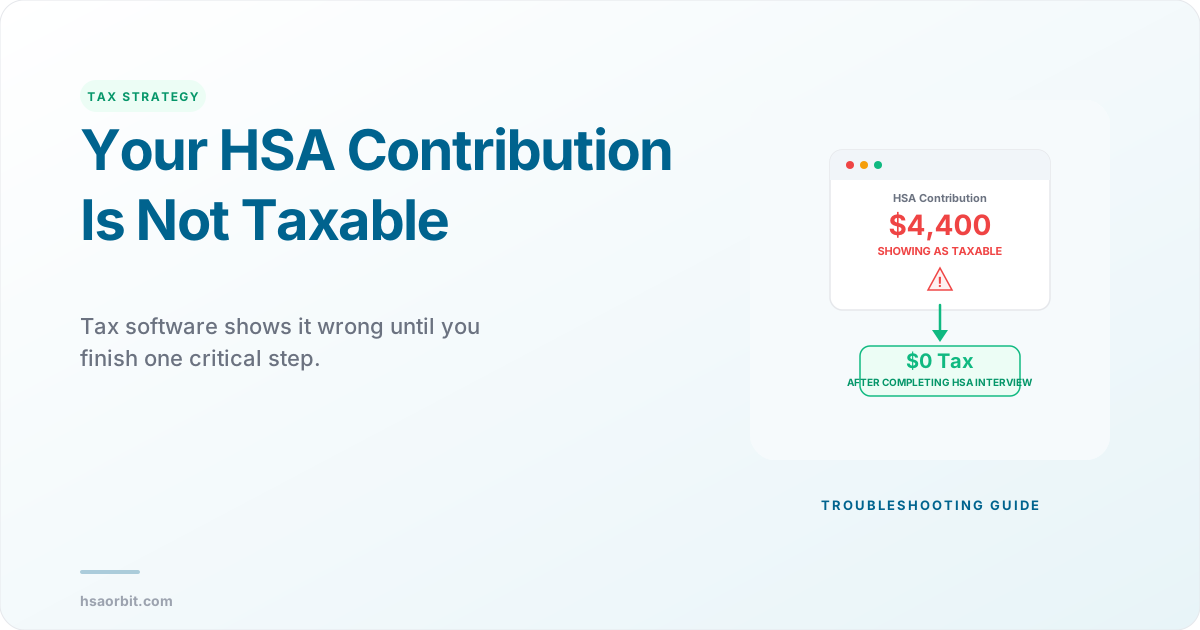
You open TurboTax in early April, ready to file. Your employer deposited $3,000 into your HSA through payroll. You contributed another $1,300 from your checking account. Total: $4,300. You enter both amounts on your return and hit submit. Three months later, an IRS notice arrives. You have a $3,000 excess contribution. You now owe a $180 penalty for 2025, and another $180 for every year that excess sits in your account. What happened? You reported your payroll contributions twice. This single HSA tax mistake is costing real people thousands of dollars during every filing season. The worst part is that most mistakes like this are completely preventable if you know what to watch for.
Form 8889 must be filed if you, your employer, or someone else made contributions to your HSA, or if your HSA made a distribution. But between W-2 codes, contribution timing rules, and pro-ration requirements, HSA reporting has become a minefield. Let me walk you through the seven most expensive HSA tax mistakes people make and exactly how to avoid or fix each one.
Why HSA Tax Mistakes Are So Common
HSA reporting sits at a strange intersection of health insurance rules, payroll tax law, and retirement account regulations. Box 12 Code W on your W-2 shows the combined total of employer and employee payroll contributions, with no breakdown of who contributed what. Most tax software asks you to enter "your" contributions separately, creating confusion about what to report where.
For 2025, the contribution limit is $4,300 for self-only coverage and $8,550 for family coverage.
If you are age 55 or older at the end of the tax year, you can contribute an additional $1,000. These limits sound straightforward until you factor in mid-year coverage changes, spousal contributions, and the peculiar last-month rule that lets you contribute the full annual amount even if you were only eligible for one month.
The stakes are real. If you exceed the annual contribution limit, you must pay a 6% excise tax on excess contributions, and the excise tax applies to each tax year the excess contribution remains in the account.
If you receive distributions for other reasons, the amount you withdraw will be subject to income tax and may be subject to an additional 20% tax. A $500 mistake can easily cost you $100 immediately, plus $30 per year in ongoing penalties if you do not fix it.
Mistake 1: Double-Counting Payroll Contributions as a Deduction
This is the single most common HSA filing error, and it happens because of how payroll contributions are reported. When you contribute to your HSA through payroll deduction, that money is already excluded from your taxable income. Your Box 1 wages on your W-2 are already reduced by the amount you contributed. But many filers see the question "How much did you contribute to your HSA?" and enter the full amount again, claiming a second deduction for money that was never taxed in the first place.
Here is how the reporting actually works. Both employer and pre-tax employee HSA contributions made through payroll are reported on Form W-2 in Box 12 with Code W as a single aggregated amount. When you enter your W-2 into tax software, that Box 12-W amount automatically flows to line 9 of Form 8889. You should not enter anything additional on line 2 unless you made direct contributions to your HSA from your personal bank account after taxes were withheld.
Let me show you what this looks like with real numbers. Sarah works for a company that contributes $1,000 to her HSA each year. She also contributes $3,300 through payroll deduction from her paychecks. Her W-2 shows $4,300 in Box 12-W. That entire amount already received favorable tax treatment. When Sarah files her taxes, she should enter zero on the personal contributions line. If she enters $3,300 there, she is claiming a deduction for money that was never in her taxable income to begin with.
How to fix it: Before you file, look at your W-2 Box 12. Do you see Code W? That is your total payroll contribution. Now look at your HSA year-end statement. If the total on your statement matches Box 12-W, do not enter anything on line 2 of Form 8889. Only enter an amount on line 2 if you made additional contributions by check or bank transfer that are not included in Box 12-W.
If you already filed and claimed both, you will need to file an amended return using Form 1040-X. Generally, for a credit or refund, you must file Form 1040-X within 3 years after the date you filed your original return or within 2 years after the date you paid the tax, whichever is later. The sooner you catch this, the better. The IRS will eventually catch the mismatch when they receive your Form 5498-SA showing total contributions.
Mistake 2: Filing Without Form 8889
Some people think that if all their HSA contributions came through payroll and all their distributions were for medical expenses, they do not need to file anything. Wrong. You must file Form 8889 if you, your employer, or someone else made contributions to your HSA, if your HSA made a distribution, or if you received HSA distributions, even if you have no taxable income or other reason for filing.
Form 8889 serves three purposes. It reports your contributions and calculates your deduction. It reports your distributions and determines if any are taxable. It calculates penalties for excess contributions or for failing testing period rules. All three of these functions matter, even if you think everything was handled correctly.
Skipping Form 8889 is not a small oversight. The IRS receives copies of your Form 1099-SA showing distributions and your Form 5498-SA showing contributions. When you do not file Form 8889, the IRS has no way to reconcile these amounts. They do not know if your distributions were for qualified medical expenses or if you stayed within contribution limits. In many cases, the IRS will assume the worst and assess penalties and taxes on amounts that should have been tax-free.
The cost varies by situation. If you took distributions, the IRS might treat all of them as taxable income plus the 20% penalty. On a $2,000 distribution at a 22% tax bracket, that is $440 in income tax plus $400 in penalties, totaling $840 on money that should have cost you nothing if properly documented.
How to fix it: If you forgot to file Form 8889 with your original return, you need to file an amended return using Form 1040-X, Amended U.S. Individual Income Tax Return. Attach your completed Form 8889 to the 1040-X. In the explanation section, simply state "Filing Form 8889 to report HSA activity inadvertently omitted from original return."
Pro Tip
Pro tip: Set a calendar reminder to review your HSA year-end statement in January before tax season. Compare the contribution total to your W-2 Box 12-W. This five-minute check catches most problems before you file.
Mistake 3: Exceeding the Contribution Limit Without Noticing
Contribution limits sound simple until you realize that contributions from multiple sources all count toward the same limit. If your HSA contribution limit for the year is $4,300 and your employer contributes $1,000, you can only contribute $3,300 yourself unless you are eligible for the catch-up contribution. People exceed the limit in several common scenarios.
You changed jobs mid-year and both employers contributed. You enrolled in Medicare partway through the year but kept contributing. Your spouse also has family HDHP coverage and you both contributed the family maximum. You set up automatic monthly contributions but forgot to account for the employer's annual contribution. Or you calculated your limit incorrectly when you only had HDHP coverage for part of the year.
A 6% excise tax is applied to the HSA owner on all excess contributions, and the 6% excise tax is cumulative and will continue in future years if a corrective withdrawal is not made. That means a $1,000 excess costs you $60 per year, every year, until you remove it. After five years, you have paid $300 in penalties on top of the taxes owed on the excess amount.
Here is a real-world example. Marcus had self-only HDHP coverage for the full year 2025. His employer contributed $500. Marcus set up $400 monthly contributions through payroll, totaling $4,800 for the year. Combined with his employer's $500, his total was $5,300. The limit was $4,300. Marcus has a $1,000 excess contribution. He owes $60 in excise tax for 2025. If he does not withdraw the excess by April 15, 2026, he will owe another $60 for 2026, and so on.
How to fix it: To avoid the penalty, you can withdraw excess contributions from your account before the deadline to file taxes, or by the extension deadline if you file for one. Contact your HSA provider and request a "return of excess contributions" form. You will need to withdraw the excess amount plus any earnings attributable to it.
Your HSA provider will send you a Form 1099-SA with Code 2 in Box 3, showing the return of excess contribution. The earnings portion is taxable income, but you avoid the ongoing 6% penalty. If you have already filed your return, you will need to amend it using Form 1040-X to report the corrected contribution amount and the excess withdrawal.
Mistake 4: Forgetting to Pro-Rate for Partial-Year HDHP Coverage
You must be an eligible individual on the first day of a month to take an HSA deduction for that month. If you enrolled in an HDHP on March 15, you can only contribute for the months starting in March. But the calculation is not intuitive, and many people contribute the full annual limit without realizing they need to pro-rate.
You calculate your prorated contribution by counting the number of months you were enrolled in an HSA-eligible health plan on the first of a month, dividing by 12, and multiplying by the annual limit. Let me show you with an example. Jessica started a new job on August 10, 2025, and enrolled in her employer's HDHP. She was covered starting September 1. She had self-only coverage. She can contribute for September through December, which is 4 months. Her pro-rated limit is 4/12 of $4,300, which equals $1,433.33. If Jessica contributed $4,300, she has a $2,866.67 excess.
There is one major exception: the last-month rule. Under the last-month rule, if you are an eligible individual on the first day of the last month of your tax year (December 1 for most taxpayers), you are considered an eligible individual for the entire year. But you must remain eligible during a testing period that runs through December 31 of the following year. If you fail the testing period because you lose HDHP coverage or enroll in Medicare, you must include the excess contributions in income and pay a 10% penalty.
The last-month rule is a trap for people who retire or change jobs. Tom was eligible on December 1, 2025, so he contributed the full $4,300. He retired March 1, 2026, and enrolled in Medicare. He failed the testing period. Because he did not remain an eligible individual during the testing period, he must include in income the contribution made that would not have been made except for the last-month rule, and a 10% additional tax applies to this amount.
How to fix it: Calculate your eligibility month by month before you file. You were eligible for any month where you had HDHP coverage on the first day of that month. Multiply the number of eligible months by 1/12 of the annual limit. That is your personal limit. If you exceeded it, request a return of excess contributions before April 15, 2026 for the 2025 tax year.
Last-Month Rule Warning
The last-month rule lets you contribute a full year's amount if you are eligible on December 1, but failing the 13-month testing period triggers income tax plus a 10% penalty on the difference. Only use this rule if you are certain you will maintain HDHP coverage through the entire next calendar year.
Mistake 5: Reporting Non-Qualified Distributions as Qualified
Your HSA distributions are tax-free only if you use them for qualified medical expenses. You can receive tax-free distributions from your HSA to pay or reimburse qualified medical expenses you incur after you establish the HSA, but if you receive distributions for other reasons, the amount you withdraw will be subject to income tax and may be subject to an additional 20% tax. The problem is that the IRS does not automatically know which expenses were qualified. You must track this yourself.
Many people assume that if they used their HSA debit card at a pharmacy or doctor's office, the expense automatically qualifies. Not true. Some common expenses that people think are qualified but are not include gym memberships (unless prescribed for a specific medical condition), vitamins and supplements (unless prescribed), cosmetic procedures, and most dental cosmetic work like whitening. The HSA debit card does not block non-qualified purchases.
If you made non-qualified distributions, you are taxed on the distribution at your ordinary income tax rate, and if you have not reached age 65, you also face a 20% penalty on the withdrawn funds. On a $1,000 non-qualified distribution at a 22% tax bracket, you owe $220 in income tax plus $200 in penalties, totaling $420. That makes your HSA less favorable than a regular checking account.
The reporting happens on Form 8889 Part II. Line 14a shows your total distributions from Form 1099-SA. Line 15 shows your qualified medical expenses. The difference on line 16 is taxable. The penalty is waived for distributions made after you are disabled, reach age 65, or die.
How to fix it: If you took a distribution for a non-qualified expense by mistake, you have two options. The cleanest approach is to pay the money back by depositing it into your HSA within 60 days and treating it as a mistaken distribution. Alternatively, report it accurately on your Form 8889 as a non-qualified distribution, pay the taxes and penalty, and learn the lesson for next year. Keep receipts for all qualified expenses. The IRS can audit HSA distributions for up to three years after filing, and you need documentation to prove expenses were qualified.
Good to Know
Keep your receipts forever. There is no time limit on when HSA withdrawals need to be made to pay for (or reimburse payments for) qualified medical expenses, provided adequate records are kept. Many people pay medical expenses out of pocket, save the receipts, and reimburse themselves years later when they need the cash for something else.
Mistake 6: Missing the Prior-Year Contribution Opportunity
Most people think HSA contributions must be made by December 31. Not true. You can make contributions to your HSA for 2025 through April 15, 2026. This is one of the best-kept secrets in HSA planning.
This extended deadline means you have more than three additional months after the calendar year ends to max out your contributions. You can see how much income you actually earned, calculate your tax savings, and decide whether to top off your HSA before filing your return. If you received a year-end bonus or had a good financial year, you can use some of that windfall to fund your HSA and reduce your tax bill for the prior year.
Here is how it works. You designate the contribution as being for the prior tax year when you make the deposit. Most HSA providers have a field on their contribution form or website that lets you specify which year to apply the contribution to. Your HSA provider will report it on the Form 5498-SA for the year you designated, not the year the money hit the account.
The catch is timing. Contributions made between January 1 and April 15, 2026 must be clearly designated for the 2025 tax year when deposited. If you do not designate them as prior-year contributions, they will count toward your 2026 limit by default. Once you file your tax return for 2025, you cannot change your mind and add more 2025 contributions later, even if you are before April 15.
People miss this opportunity for several reasons. They do not know about the extended deadline. They think their HSA closed at year-end. They forgot to check if they maxed out their contribution before filing. Or they filed their taxes in January, weeks before the deadline, not realizing they had time to add more contributions.
How to fix it: Before you file your 2025 tax return in 2026, check your total contributions for 2025. Look at your year-end HSA statement and your W-2 Box 12-W. Add them together. If the total is less than your limit ($4,300 for self-only or $8,550 for family, plus $1,000 catch-up if you are 55 or older), you can still make additional contributions until April 15, 2026. Call your HSA provider, make the contribution, and clearly specify it is for tax year 2025. Then report the full amount on your Form 8889 when you file.
You can check your contribution limit based on your coverage type and age to make sure you are maximizing your tax savings.
Mistake 7: Ignoring State Taxes on HSA Contributions
The federal government treats HSA contributions as tax-deductible and HSA earnings as tax-free. But two states play by different rules. California and New Jersey do not adopt the federal income tax treatment of HSAs, so contributions are after-tax for state income tax purposes in those states. This creates a reporting headache and reduces the tax benefit for residents.
Employer and employee HSA contributions through payroll are treated as taxable income for California and New Jersey state income tax purposes, subject to state withholding and payroll taxes, and reported as taxable state income on Form W-2 Box 16. Your federal return shows the HSA deduction, but your state return must add it back as income.
Employees also do not receive the same tax-free growth as provided at the federal level. Interest, dividends, and capital gains inside your HSA are taxable for California and New Jersey state tax purposes. You must track these earnings yourself because your HSA provider does not issue state-specific tax forms. You report the income on your state return even though you did not receive a 1099 for it.
The math still works out in favor of HSAs for most California and New Jersey residents because you still get the federal deduction, FICA tax savings on payroll contributions, and state tax-free withdrawals for medical expenses. But people make mistakes when they do not adjust their state returns correctly. They either forget to add back the HSA contribution as state income, or they forget to report HSA earnings, or they fail to claim the state medical expense deduction when they take distributions.
How to fix it: If you live in California or New Jersey, your HSA contributions are not deductible on your state return. You must add them back as income. When you take distributions for medical expenses, those expenses may be deductible on your state return because the state treats your HSA like a regular bank account. Consult with a tax professional familiar with California or New Jersey HSA rules, because the tracking and reporting requirements are complex. Most tax software does not handle this automatically, so you need to make manual adjustments.
Important
California and New Jersey residents: Your state does not recognize HSA tax benefits. Contributions are taxable at the state level, and earnings inside your HSA must be reported as state income annually. Factor this into your decision about whether an HDHP with an HSA is the right choice for your situation.
How to Fix Each Mistake If You Have Already Filed
Discovering a mistake after filing feels terrible, but the IRS has a process for corrections. File Form 1040-X, Amended U.S. Individual Income Tax Return. Generally, for a credit or refund, you must file Form 1040-X within 3 years after the date you filed your original return or within 2 years after the date you paid the tax, whichever is later.
Here is the process for each mistake. For double-counted contributions, file Form 1040-X with a corrected Form 8889 showing only your non-payroll contributions on line 2. Your refund will be the tax you overpaid on the incorrectly reduced income. For missing Form 8889 entirely, file Form 1040-X with Form 8889 attached. In most cases, this will show you owe less tax than the IRS calculated without the form.
For excess contributions discovered after filing, contact your HSA provider immediately to request a return of excess contributions. There is a special rule that lets you take a corrective distribution up to six months after the due date of your return including extensions if you file an amended return. You must include an explanation of the withdrawal and file an amended Form 5329 if you originally reported the excess.
For pro-ration errors, the fix is the same as excess contributions. Calculate your correct pro-rated limit, request return of the excess, and file an amended return. For non-qualified distributions you reported as qualified, file an amended Form 8889 showing the correct amount on line 15 and paying the taxes and penalties on line 16.
For missed prior-year contributions, there is no fix after you file your return and the April 15 deadline passes. You cannot amend a return to add contributions that were not made within the allowable period. This is why you should always check your contribution total before filing. For state tax errors, file an amended state return following your state's procedures. California uses Form 540-X and New Jersey uses Form NJ-1040X.
Allow 8 to 12 weeks for your amended return to be processed, though in some cases processing can take up to 16 weeks. If you owe additional taxes, pay them when you file the amendment to minimize interest charges. The IRS charges interest on unpaid taxes from the original due date of the return, not from the date you discovered the error.
You can verify your expenses are qualified before taking distributions to avoid the non-qualified distribution penalty.
Frequently Asked Questions
Q: What happens if I contribute to my HSA after enrolling in Medicare?
You cannot deduct contributions for any month in which you were enrolled in Medicare. Contributions made after Medicare enrollment are excess contributions subject to the 6% excise tax. Many people enroll in Medicare at age 65 but do not realize they need to stop HSA contributions immediately, not at the end of the year.
Q: Can I use my HSA to reimburse medical expenses from before I opened the account?
No. You can receive tax-free distributions from your HSA to pay or reimburse qualified medical expenses you incur after you establish the HSA. The date the HSA was established is critical. You cannot use 2026 HSA funds to reimburse 2025 expenses if you opened the HSA in 2026.
Q: Do I need receipts for HSA distributions if I used my HSA debit card?
Yes. The HSA debit card is a convenience, not proof that expenses were qualified. You must keep records showing the expenses were qualified medical expenses, and you should keep them with your tax records but not send them with your return. The IRS can audit HSA distributions for up to three years, and you need documentation to avoid taxes and penalties.
Q: What if my employer made a mistake and contributed too much to my HSA?
To avoid the 6% excise tax on excess contributions, you must work directly with the HSA custodian to take a corrective distribution of the excess contributions adjusted for earnings before the tax filing deadline. The employer should also issue a corrected W-2 if the error is discovered in time.
Q: Can I fix an HSA mistake from a prior year that I did not catch until now?
Yes, but you must file an amended return for each year with the mistake. You must file Form 1040-X within 3 years after the date you filed your original return. If the mistake involved excess contributions that are still in your account, you have been paying the 6% excise tax each year. Remove the excess immediately to stop future penalties, even if you cannot recover past penalties.
Written by
David is a licensed attorney and SHRM Senior Certified Professional who covers HSA compliance, IRS regulations, and employer benefits law. He previously practiced employee benefits law at a national firm.