If you only contributed to your HSA through payroll deductions in 2025, do you still need Form 8889? The answer is yes. You must file Form 8889 if you, your employer, or someone else made contributions to your HSA, regardless of whether those contributions were made through payroll, by direct deposit, or by your employer. This requirement surprises many taxpayers who assume that because their payroll contributions already appear on their W-2 in Box 12 with Code W, the IRS has all the information it needs. But Form 8889 serves multiple purposes beyond simply recording contribution amounts, and skipping it can create problems with your tax return that may not surface until months or even years later.
The confusion stems from how payroll HSA contributions are handled for tax purposes. Payroll contributions through a salary reduction agreement elected by an employee (a cafeteria plan) are treated as employer contributions, even though the money came from your paycheck. This classification means your contributions were already excluded from your taxable wages before you received your W-2, which is why they do not appear in Box 1 (your taxable income). Instead, both the employer and pre-tax employee HSA contributions made through payroll are reported on the Form W-2 in Box 12 with Code W as a single aggregated amount.
2025 and 2026 HSA Contribution Limits
- 2025 self-only coverage: $4,300
- 2025 family coverage: $8,550
- 2026 self-only coverage: $4,400
- 2026 family coverage: $8,750
- Catch-up contribution (age 55+): additional $1,000 for both years
- Prior-year contribution deadline: April 15, 2026 for tax year 2025
The Short Answer: Yes, You Always Need Form 8889
You must file Form 8889 if any of the following applies: you, your employer, or someone else made contributions to your HSA; your HSA made a distribution; you failed to be an eligible individual during a testing period and must recognize income. The requirement applies whether you contributed $50 or the full annual limit, and whether those contributions came through payroll deduction, direct deposit from your checking account, or employer contributions.
The IRS is explicit about this requirement. If you (or your spouse, if filing jointly) received HSA distributions in 2025, you must file Form 8889 with Form 1040, Form 1040-SR, or Form 1040-NR, even if you have no taxable income or any other reason for filing. But the filing requirement extends beyond just distributions. Even if you never touched the money in your HSA during the tax year, the mere fact that contributions were made triggers the requirement to file Form 8889.
You must always file a Form 8889 in any year you or an employer contributes money to your HSA, or you make withdrawals from the account. This applies even when your contributions were entirely through payroll deduction and appear correctly on your W-2.
Why the IRS Requires Form 8889 for Payroll Contributions
Understanding why the IRS requires Form 8889 even for payroll-only contributors requires looking at what the form actually does. Form 8889 serves four distinct purposes that your W-2 alone cannot accomplish.
First, the form verifies your HSA eligibility for each month of the year. To be eligible to have contributions made to your HSA, you must be covered under a high deductible health plan (HDHP) and have no other health coverage except certain disregarded coverage. Your employer's payroll system does not track whether you enrolled in Medicare mid-year, got married and gained coverage under your spouse's non-HDHP plan, or changed jobs and lost HDHP coverage. Form 8889 requires you to calculate your contribution limit based on your actual eligibility each month.
Second, the form ensures contributions did not exceed annual limits. If you have self-only coverage, your maximum contribution is $4,300 for 2025. If you have family coverage, your maximum contribution is $8,550. If you are age 55 or older at the end of your tax year, you can make an additional contribution of $1,000. If you changed jobs during the year and both employers contributed to your HSA through payroll, your W-2s would show separate amounts in Box 12 Code W, but neither employer would know about the other's contributions. Form 8889 is where you add up all contributions from all sources to determine whether you exceeded the limit.
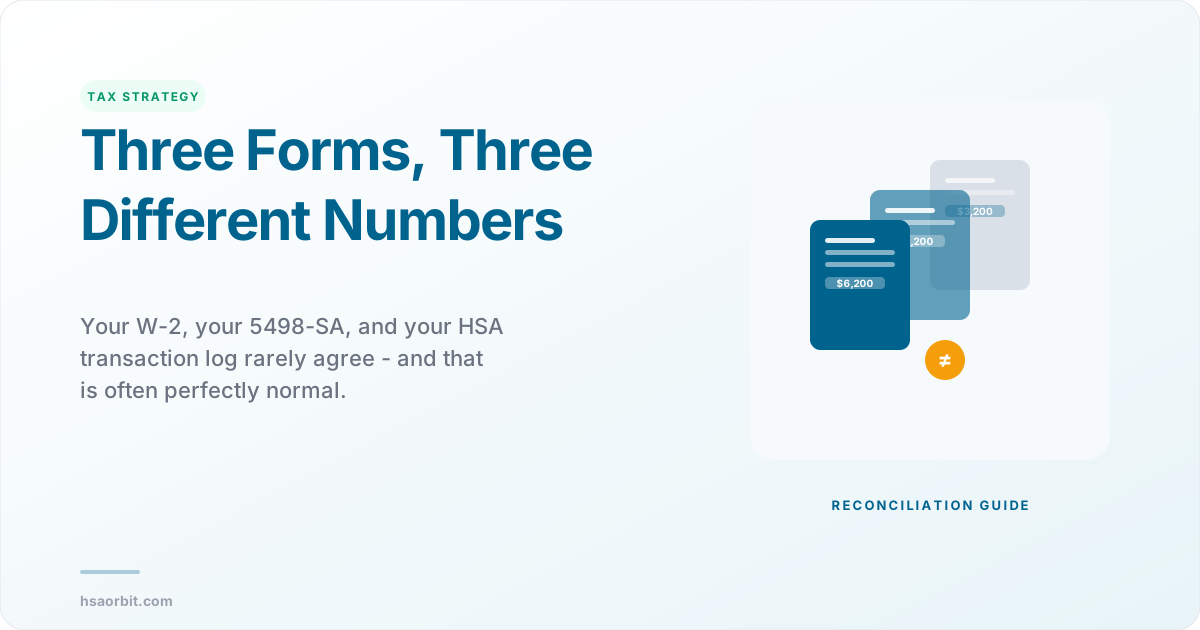
Third, Form 8889 documents your HSA basis for future distributions. While this may not seem important when you are only contributing, it becomes critical when you eventually take distributions. The IRS cross-references your reported contributions each year with the Forms 5498-SA that HSA custodians file directly with the IRS. When they see HSA contributions on your W-2 and Form 5498-SA from your HSA provider but no corresponding Form 8889, it creates a discrepancy that could trigger automated notices down the road.
Fourth, the form calculates your HSA deduction. Even though payroll contributions were already excluded from your taxable income, the deduction calculated on Form 8889 Line 13 must be transferred to Schedule 1 (Form 1040), Line 13. Combine the amounts on line 13 of both Forms 8889 and enter this amount on Schedule 1 (Form 1040), line 13. Be sure to attach both Forms 8889 to your paper tax return. Without this form, the connection between your HSA contribution and your tax return is incomplete, even though payroll contributions do not provide an additional deduction.
Good to Know
Understanding Box 12 Code W: Your W-2 shows the total of all payroll-deducted HSA contributions plus any employer contributions in Box 12 with Code W. This amount was never included in your taxable wages (Box 1), so you already received the tax benefit. Form 8889 reports this same amount on Line 9, confirming it for the IRS but not providing a second deduction.
What Happens If You Skip Form 8889
Failing to file Form 8889 when required creates several potential problems, even if you owe no additional tax. The consequences range from immediate processing delays to long-term issues with HSA compliance.
The most immediate consequence is that failing to file Form 8889 can lead to IRS penalties, unreported taxable income, or loss of deductions. While you may not face a direct penalty for the missing form itself, the IRS automated systems match forms. Your HSA custodian files Form 5498-SA with the IRS showing your total contributions for the year. Your employer reports contributions in Box 12 Code W of your W-2. When the IRS systems see these forms but no Form 8889 on your tax return, the mismatch triggers automated correspondence.
The main issue is that Form 8889 establishes your HSA basis (the amount you have contributed), which is important when you eventually start taking distributions. Without proper tracking through Form 8889 each year, you could face problems proving which distributions are qualified tax-free withdrawals in the future. Additionally, if you had any excess contributions, those would need to be addressed on this form.
The IRS may send you a notice asking why Form 8889 was not included with your return. Responding to IRS notices consumes time and creates stress, even when the issue is merely a missing form rather than additional tax owed. You may need to file an amended return (Form 1040-X) with the missing Form 8889 attached, which delays any refund you were expecting and extends the time your return remains under IRS review.
More seriously, if you had excess contributions that should have been reported on Form 8889, skipping the form means you never calculated whether you exceeded the annual limit. Code section 4973 imposes a 6% tax on excess contributions to an HSA. See Code section 4973 and Form 5329. This penalty applies every year the excess amount remains in your account. If you changed jobs mid-year and both employers contributed through payroll without coordinating, you could easily exceed the limit without realizing it. Without Form 8889, you would never catch this error, and the 6% penalty would compound each year.
Failing to file Form 8889 when required can lead to disallowed HSA deductions, tax penalties for unreported excess contributions, and IRS delays or notices for incomplete tax returns. Even if your return is accepted initially, the IRS has three years to audit returns and can assess penalties and interest retroactively.
Important
Excess contributions carry ongoing penalties: If you contributed more than the annual limit, the 6% excise tax applies every year until you remove the excess. For a $500 excess contribution, that is $30 per year, every year, until corrected. Form 8889 is where you calculate whether you exceeded the limit.
How to File Form 8889 When All Contributions Were Through Payroll
Filing Form 8889 when you only contributed through payroll is actually simpler than filing when you made additional contributions outside of payroll. The form has three parts, but payroll-only contributors typically complete only Part I (HSA Contributions and Deduction) and leave Parts II and III blank if there were no distributions or special circumstances.
Start by gathering your documents. You need your W-2 showing Box 12 Code W, which reports your total payroll contributions for the year. If you took any distributions from your HSA, you also need Form 1099-SA from your HSA custodian. Form 5498-SA, which shows your year-end account value and total contributions, is informational and helps verify your numbers but does not need to be filed with your tax return.
On Form 8889 Part I, Line 1, check the box indicating your HDHP coverage type. If you were covered, or considered covered, by a self-only HDHP and a family HDHP at different times during the year, check the box for the plan that was in effect for a longer period. If you were covered by both a self-only HDHP and a family HDHP at the same time, you are treated as having family coverage during that period. If, on the first day of the last month of your tax year (December 1 for most taxpayers), you had family coverage, check the family box.
Line 2 asks for contributions you made for 2025. This is where the confusion typically occurs. On line 2, the IRS asks you to report contributions you made for 2025, or contributions made on your behalf, but that does not include any money you contributed through payroll deductions. Instead, it is asking how much you contributed outside of payroll deductions. If you only contributed through payroll, Line 2 is zero. You do not enter your payroll contributions here because those will be reported on Line 9.
Check your contribution limit for the year
Lines 3 through 8 calculate your contribution limitation based on your coverage type and the number of months you were eligible. If you had the same HDHP coverage all 12 months of 2025, Line 3 will be the full annual limit for your coverage type. If your eligibility changed during the year, you will need to use the Line 3 Limitation Chart and Worksheet from the Form 8889 instructions to calculate a prorated limit.
Line 9 is where your payroll contributions appear. Box 12 of your W-2 shows your HSA contributions made by pretax payroll deduction, if applicable, and by your employer (labeled employer contributions and marked with code W). Enter the amount from Box 12 on your W-2 on line 9 on Form 8889. This line includes both your payroll deductions and any employer contributions, combined as a single amount.
Line 12 shows your contribution limit. Line 13 calculates your HSA deduction by subtracting Line 9 (employer and payroll contributions) from Line 12 (your limit). For payroll-only contributors, this calculation typically results in zero or a small number. Line 2 should be $0 because your contributions were made pre-tax through payroll. Line 9 shows your pre-tax contributions and you are not losing any tax benefit. The deduction on Line 13 is only for contributions you made with after-tax dollars (which you did not do). It is confusing terminology, but the tax treatment is correct.
If you had no HSA distributions during 2025, leave Part II blank. If you took distributions, enter the amount from Form 1099-SA Box 1 on Line 14a, then complete the rest of Part II to show whether those distributions were for qualified medical expenses. Part III applies only to special situations involving the last-month rule or qualified HSA funding distributions from an IRA, which most taxpayers can leave blank.
Pro Tip
Tax software does this automatically: Most tax software (TurboTax, H&R Block, TaxAct) will generate Form 8889 automatically when you enter your W-2 information. The software pulls the Box 12 Code W amount directly to Line 9 and walks you through any additional questions. You can verify the completed form before filing.
Special Cases: Mid-Year Changes, Multiple Employers, and Spouse HSAs
Several situations make Form 8889 more complex, even for payroll-only contributors. These special cases require extra attention to avoid excess contributions or incorrect deductions.
Mid-year coverage changes require prorated contribution limits. If you started HDHP coverage in July 2025, you were eligible for only six months of contributions. If you must complete the Line 3 Limitation Chart and Worksheet (in these instructions), and your eligibility and coverage did not change from one month to the next, enter the same number you entered for the previous month. After calculating the amount for each month in 2025, enter the amount on the line for that month in the worksheet, add them all together and divide by 12 to receive the limitation amount to be entered on line 3 of Form 8889. Your employer's payroll system may have deducted the full annual amount from your paychecks, not knowing you were ineligible for part of the year. Form 8889 is where you calculate the correct limit and identify any excess contributions.
The last-month rule provides an exception. Under the last-month rule, if you are an eligible individual on the first day of the last month of your tax year (December 1 for most taxpayers), you are considered an eligible individual for the entire year. You are treated as having the same HDHP coverage for the entire year as you had on the first day of the last month if you did not otherwise have coverage. This rule allows you to contribute the full annual amount even if you became eligible late in the year. However, the testing period begins with the last month of your tax year and ends on the last day of the 12th month following that month (for example, December 1, 2025, through December 31, 2026). If contributions were made to your HSA based on you being an eligible individual for the entire year under the last-month rule, you must remain an eligible individual during the testing period. If you fail the testing period, you must include the excess contribution in income and pay a 10% additional tax, calculated in Form 8889 Part III.
Multiple employers create the highest risk of excess contributions. If you changed jobs during 2025 and both employers offered HSA contributions through payroll, each employer contributed independently without knowing about the other. You receive separate W-2 forms, each showing contributions in Box 12 Code W. Form 8889 requires you to add contributions from both employers and compare the total to the annual limit. Your maximum contribution is reduced by any employer contributions to your HSA, any contributions made to your Archer MSA, and any qualified HSA funding distributions. Any amount above the limit is an excess contribution subject to the 6% penalty.
Married couples filing jointly face additional complexity when both spouses have HSAs. If married filing jointly and both you and your spouse have HSAs, complete a separate Form 8889 for each of you. Combine the amounts on line 13 of both Forms 8889 and enter this amount on Schedule 1 (Form 1040), line 13. Be sure to attach both Forms 8889 to your paper tax return. When both spouses have family HDHP coverage, special allocation rules apply. If you were covered by both a self-only HDHP and a family HDHP at the same time, you are treated as having family coverage during that period. If you and your spouse are considered covered by a family HDHP, you are considered covered by a family HDHP regardless of whether you file jointly or separately. The family contribution limit must be allocated between the two HSAs, typically split equally unless you agree to a different allocation.
How Tax Software Handles Payroll-Only HSA Contributions
Modern tax preparation software simplifies Form 8889 filing significantly, but understanding what happens behind the scenes helps you verify the form is completed correctly.
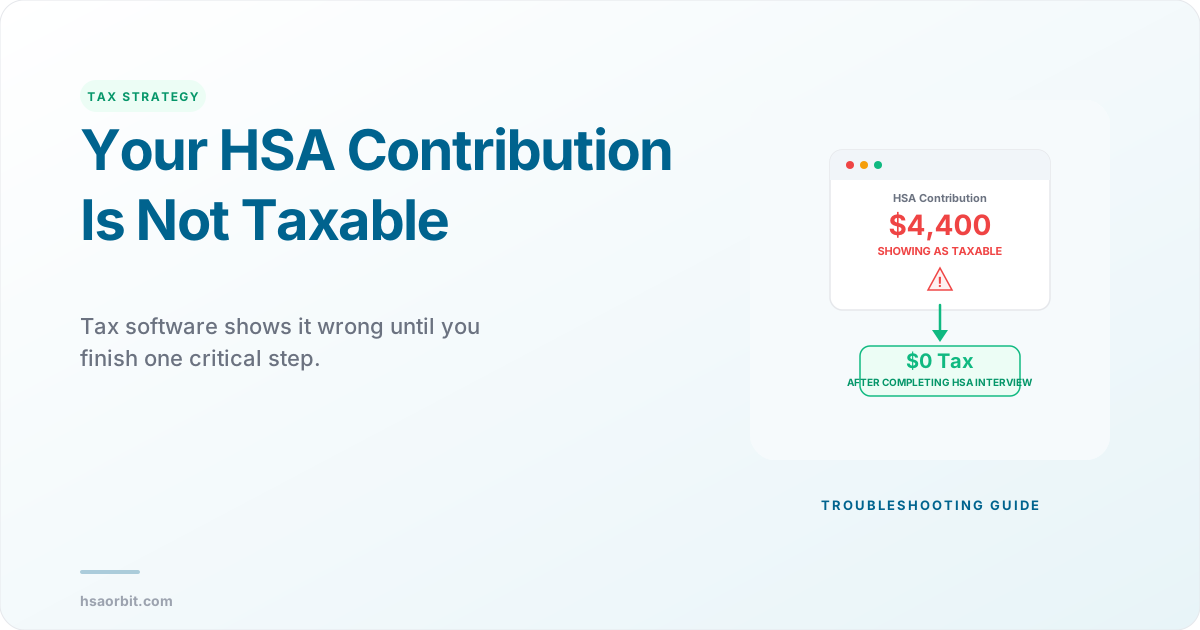
When you enter your W-2 information, the software recognizes Box 12 Code W and automatically generates Form 8889. We will automatically pull your employer contributions from your W-2 (Box 12 Code W). DO NOT enter amounts from your W-2. The software transfers the Box 12 Code W amount directly to Form 8889 Line 9.
The software then asks a series of questions about your HSA situation. You will be asked whether you had self-only or family coverage, whether your coverage changed during the year, and whether you are age 55 or older (qualifying for the catch-up contribution). Based on your answers, the software calculates your contribution limit for Line 3.
Typically, these payroll contributions are reported on your W-2 in box 12 with code W. If that is the case, no other contribution needs to be reported in the software. Under the Deductions and Credits menu, if all of your contributions were through payroll deductions and reported on your W2, do not enter anything on this screen. The software knows that payroll contributions reported in Box 12 Code W should not also be entered as personal contributions on Line 2. The most common error is double-reporting by entering the same contributions in both places.
Tax software also checks for excess contributions automatically. After calculating your contribution limit and seeing your total contributions, the software alerts you if you exceeded the limit. It will offer to calculate the 6% excise tax on Form 5329 or help you determine whether you should withdraw the excess contributions before the filing deadline to avoid the penalty.
For distributions, the software imports information from Form 1099-SA if you upload or scan your tax documents. It completes Part II of Form 8889 automatically, though you must still indicate whether the distributions were used for qualified medical expenses. Most software includes a checklist or interview asking, "Did you use all distributions from your HSA for qualified medical expenses?" Your answer determines whether Line 16 (taxable HSA distributions) shows any amount subject to income tax and the 20% penalty.
Finally, the software transfers the Line 13 deduction from Form 8889 to Schedule 1 Line 13, which flows through to Form 1040 Line 10 as an adjustment to income. Even when the Line 13 amount is zero (as it typically is for payroll-only contributors), the software still generates the complete Form 8889 and attaches it to your return, satisfying the IRS filing requirement.
Good to Know
Review the generated form: Before filing, review the completed Form 8889 in your tax software. Verify that Line 9 matches Box 12 Code W from your W-2, that Line 2 is zero (if you only contributed through payroll), and that your contribution limit on Line 3 is correct for your coverage type. These quick checks catch the most common errors.
Frequently Asked Questions
Q: If my HSA contributions are already on my W-2, why does the IRS need Form 8889? Your W-2 shows what you contributed, but Form 8889 verifies your eligibility, calculates whether you exceeded limits, and establishes your HSA basis for future distributions. The IRS cross-references Form 8889 with Forms 5498-SA that HSA custodians file directly, and mismatches trigger notices.
Q: Can I deduct my payroll HSA contributions twice by reporting them on Form 8889? No. For tax purposes, contributions made through payroll deduction are treated as employer contributions even though the money is coming from your salary. This is because they were never included in your taxable income in the first place (they were pre-tax deductions). Line 2 of Form 8889 is for after-tax contributions only. Payroll contributions go on Line 9 and do not generate an additional deduction.
Q: What happens if I contributed through payroll at two different jobs in the same year? You must add the Box 12 Code W amounts from both W-2 forms and report the combined total on Form 8889 Line 9. If the combined amount exceeds the annual limit ($4,300 for self-only or $8,550 for family coverage in 2025), you have excess contributions subject to a 6% penalty unless you withdraw the excess before the tax filing deadline.
Q: I only contributed through payroll and never took any distributions. Do I still need Form 8889? Yes. You must file Form 8889 if any of the following applies: you, your employer, or someone else made contributions to your HSA. The filing requirement applies regardless of whether you took distributions. Even with no distributions, you still complete Part I of Form 8889 and leave Parts II and III blank.
Q: Do I need to attach my Form 5498-SA showing my HSA contributions to my tax return? No. Since contributions for 2025 can be made to HSAs up until the federal tax deadline, HSA administrators are not required to send out Form 5498-SA, which is an informational document showing your total contribution amount, until May. If you have an online account, however, you should be able to log in to see your total contributions for the year. If you do receive Form 5498-SA, you are not required to file it with your taxes. Form 5498-SA is for your records and verification purposes only.
Written by
David is a licensed attorney and SHRM Senior Certified Professional who covers HSA compliance, IRS regulations, and employer benefits law. He previously practiced employee benefits law at a national firm.