Every year, the IRS adjusts HSA contribution limits to keep pace with inflation and rising healthcare costs. For 2026, the limits have increased again, giving HSA holders more room to save and invest tax-free. Whether you are new to HSAs or a seasoned maximizer, understanding the exact limits, deadlines, and rules is essential to capturing every dollar of tax savings available to you - and avoiding the penalties that come with exceeding them.
2026 IRS Contribution Limits
- Self-only HDHP coverage: $4,400 per year
- Family HDHP coverage: $8,750 per year
- Catch-up contribution (age 55+): Additional $1,000
These limits represent an increase from 2025 ($4,300 self-only and $8,550 family), reflecting the IRS's annual cost-of-living adjustments. The limits include all contributions from every source - your personal deposits, employer contributions, and any contributions made on your behalf. You cannot exceed the annual cap from all sources combined.
| Coverage Type | 2026 Limit |
|---|---|
| Self-only coverage | $4,400 |
| Family coverage | $8,750 |
| Catch-up contribution (age 55+) | +$1,000 |
Source: IRS Revenue Procedure. Limits include employer contributions.
How the Limits Work
Self-Only vs. Family Coverage
Your contribution limit is determined by the type of High Deductible Health Plan (HDHP) you carry, not the number of people in your household. If you have self-only HDHP coverage, your limit is $4,400 - regardless of whether you are married or have children. If you have family HDHP coverage (meaning your plan covers at least one other person), your limit rises to $8,750.
This distinction creates an interesting planning opportunity for married couples:
Good to Know
If both you and your spouse each carry self-only HDHP coverage through your respective employers, each of you can contribute $4,400 to your own separate HSA - for a combined household total of $8,800. This actually exceeds the $8,750 family limit by $50. In this scenario, two self-only plans produce a higher combined contribution ceiling than one family plan.
When a married couple shares one family HDHP, the $8,750 limit applies to the household. Both spouses can split contributions between their individual HSAs in any proportion, but the total across both accounts cannot exceed $8,750 (plus catch-up contributions, if applicable).
Catch-Up Contributions
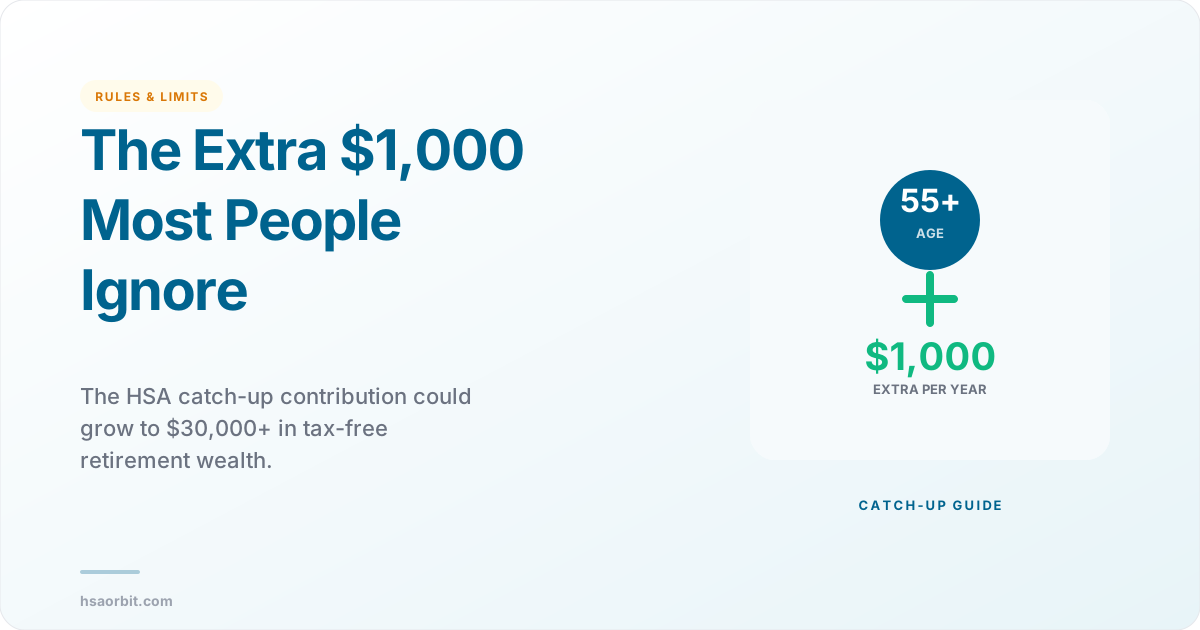
If you are age 55 or older by December 31, 2026, you can contribute an additional $1,000 above the standard limit. This catch-up amount has remained fixed at $1,000 since HSAs were created in 2004 - unlike the base limits, it is not adjusted for inflation.
With the catch-up, a 55+ individual with self-only coverage can contribute up to $5,400, and a 55+ individual with family coverage can contribute up to $9,750.
Pro Tip
If both spouses are 55 or older, each can make the $1,000 catch-up contribution - but it must go into the account owned by the person who qualifies. You cannot deposit your catch-up contribution into your spouse's HSA. This means the household total for a 55+ couple with family coverage can reach $10,750 ($8,750 base + $1,000 + $1,000), split across two accounts.
Employer Contributions
Many employers contribute to their employees' HSAs as part of their benefits package - often between $500 and $2,000 per year. These employer contributions count toward your annual limit. If your employer deposits $1,000 into your self-only HSA, you can only contribute $3,400 personally to stay within the $4,400 cap.
Important
Employer contributions are reported on your W-2 in Box 12, Code W, alongside your pre-tax payroll contributions. The combined total appears as a single figure. Verify this amount carefully when filing your taxes - if the total exceeds the annual limit, you are responsible for correcting the excess, not your employer.
Employer contributions are not subject to income tax or FICA tax, making them extremely valuable. If your employer offers HSA matching or seed contributions, always contribute enough to capture the full employer match before directing money elsewhere.
HDHP Requirements for 2026
You can only contribute to an HSA if you are enrolled in a qualifying High Deductible Health Plan. For 2026, the IRS defines an HDHP using two thresholds that your plan must satisfy simultaneously:
2026 HDHP Qualification Thresholds
Self-only coverage:
- Minimum annual deductible: $1,650
- Maximum annual out-of-pocket: $8,300
Family coverage:
- Minimum annual deductible: $3,300
- Maximum annual out-of-pocket: $16,600
Your plan must meet both the minimum deductible and the maximum out-of-pocket limit to qualify as an HDHP. A plan with a $2,000 deductible but a $10,000 out-of-pocket maximum for self-only coverage would not qualify because it exceeds the $8,300 out-of-pocket ceiling.
Plans with lower deductibles or higher out-of-pocket costs do not qualify, even if they are marketed as "high deductible." If you are unsure whether your plan qualifies, check with your employer's benefits department or your insurance carrier - they are required to know whether the plan meets HDHP criteria.
In addition to HDHP enrollment, you must not be enrolled in Medicare, not be claimed as a dependent on another person's tax return, and not have disqualifying coverage such as a general-purpose FSA or non-HDHP health plan. Use our eligibility checker to confirm your HSA qualification status.
Key Deadlines
Contribution Deadline
You have until April 15, 2027 - the tax filing deadline for the 2026 tax year - to make HSA contributions that count toward 2026. This extended window gives you several extra months to maximize your contributions after the calendar year ends, similar to how IRA contributions work.
Pro Tip
Even if you cannot max out your HSA during the calendar year, you can make a lump-sum contribution in early 2027 (before April 15) to reach the limit. If you receive a tax refund in February or March, consider directing it straight into your HSA to capture the deduction.
Mid-Year Coverage Changes
If you gain or lose HDHP coverage during the year, your contribution limit is prorated based on the number of months you were eligible. Each month of eligibility earns you 1/12 of the annual limit. For example, if you had self-only HDHP coverage for 9 months, your prorated limit would be $3,300 (9/12 of $4,400).
However, there is a valuable exception called the last-month rule: if you are HDHP-eligible on December 1, 2026, you can contribute the full annual amount regardless of how many months you were actually covered. The catch is that you must remain HDHP-eligible through December 31, 2027 - a 13-month testing period. If you fail the testing period (by switching to a non-HDHP plan, enrolling in Medicare, etc.), the excess contributions become taxable income and are subject to a 10% penalty.
Important
The last-month rule is powerful but carries real risk. If you use it and then change jobs to an employer that does not offer an HDHP, you will owe taxes and a penalty on the excess. Only use this rule if you are confident you will maintain HDHP coverage through the full testing period.
Over-Contribution Penalties
Exceeding the annual limit triggers a 6% excise tax on the excess amount for each year it remains in the account. This penalty recurs annually until you correct the mistake - it is not a one-time charge.
Identify the Excess Amount
Calculate the total contributions from all sources (personal, payroll, employer) and compare against your annual limit. Remember to account for any mid-year coverage changes that may have reduced your prorated limit. Your HSA provider's year-end statement and your W-2 (Box 12, Code W) are the key documents to check.
Option A: Withdraw Before the Tax Deadline
Contact your HSA provider and request a "return of excess contributions" before April 15, 2027 (or October 15 if you file an extension). You must also withdraw any net income attributable to the excess. The excess amount is added to your taxable income for the year, and the attributable earnings are taxed as well - but you avoid the 6% excise tax entirely.
Option B: Apply to Next Year's Limit
If you do not withdraw the excess before the deadline, you can reduce next year's contributions to absorb the overage. The excess carries forward and counts against the following year's limit. However, you still owe the 6% excise tax for each year the excess remained in the account. This method is simpler but more expensive.
File the Required Tax Forms
Report any excess contributions and corrections on IRS Form 8889 (Health Savings Accounts), which you file with your federal tax return. If you owe the 6% excise tax, you must also file Form 5329 (Additional Taxes on Qualified Plans). Accurate reporting protects you from additional IRS scrutiny.
Strategies to Maximize Your Contributions
Three Ways to Maximize
Front-load your contributions. Contributing early in the year gives your money more time to grow tax-free, especially if you invest your HSA funds. A lump-sum contribution in January provides 11 extra months of potential investment growth compared to contributing in December. Over 20-30 years, front-loading can produce tens of thousands of dollars in additional growth.
Use payroll deductions. Pre-tax payroll contributions avoid both income tax and FICA taxes (7.65% for Social Security and Medicare). Direct contributions from your bank account only qualify for the income tax deduction - you still pay FICA on those dollars. At the 7.65% rate, payroll deductions save an extra $337 on a $4,400 contribution.
Coordinate with your spouse. If both spouses have access to HDHP coverage, run the numbers on two self-only plans versus one family plan. Two self-only HSAs allow a combined $8,800 in contributions ($50 more than the family limit) and give each spouse full ownership of their account.
Beyond these core strategies, consider these additional approaches to maximize the value of your HSA contributions:
- Invest above the cash threshold. Once your cash balance exceeds your provider's minimum (usually $1,000-$2,000), invest the remainder in low-cost index funds. Uninvested HSA cash earns negligible interest and loses purchasing power to inflation every year. Use our tax growth simulator to see the long-term impact of investing your HSA.
- Avoid spending HSA funds on current medical expenses if you can afford to pay out of pocket. Let your contributions compound tax-free and save receipts for future reimbursement - there is no deadline. Learn more about this strategy in our triple tax advantage guide.
- Review your provider annually. If your provider charges monthly fees or offers limited investment options, consider transferring your balance to a better provider. You are allowed one rollover per 12-month period, and trustee-to-trustee transfers are unlimited.
Good to Know
HSA contribution limits have increased every year since HSAs were created in 2004. Over the past decade, the self-only limit has risen from $3,350 (2016) to $4,400 (2026) - a 31% increase. This steady growth, combined with tax-free compounding, makes maxing out your HSA one of the highest-value financial moves you can make each year.
Start planning your 2026 HSA contributions now using our contribution calculator. The earlier you contribute, the longer your money has to compound tax-free - and the greater the tax advantage becomes over time.

Next Steps: Action Checklist
Written by
David is a licensed attorney and SHRM Senior Certified Professional who covers HSA compliance, IRS regulations, and employer benefits law. He previously practiced employee benefits law at a national firm.